
Cancer is an interdisciplinary problem and effective treatment applies research from biology, chemistry, physics, statistics, psychology, and even environmental sciences. Treatment planning is a complex issue and often combines chemotherapy, radiation, and surgery, depending on the individual. How can students begin to understand the complexities of planning cancer treatment? One way is simulations.
I first encountered the concept of fractionated radiation treatment in my first year in iSci. In my third year of iSci I chose to develop an educational model of fractionated radiation treatment planning for my independent project.
The Science
The goal of radiation treatment is to treat cancer by killing tumour cells with radiation while minimizing the damage to healthy cells. External radiation therapy commonly uses high-energy photon beams, such as x-rays and gamma rays. These high energy photons are able to damage and kill cells, and using a higher energy causes more cells to be killed. It turns out that different types of cells respond to radiation differently, and this knowledge can be used to choose a dose (energy) that causes more damage to tumour cells than healthy cells.
Experiments characterizing the response of different types of cells to radiation treatment have found that, for common types of tumour and healthy cells, low dosages do more damage to tumour cells than healthy cells. But at higher dosages, the radiation does more damage to healthy cells than tumour cells. It sounds like choosing a lower dose is the better choice; however, low doses do not kill all the cells, it just kills more tumour cells than healthy cells. The solution is to break the treatment into many fractions of low dosage radiation. Patients receiving fractionated radiation treatment typically visit the hospital for treatment every day and sometimes twice a day.
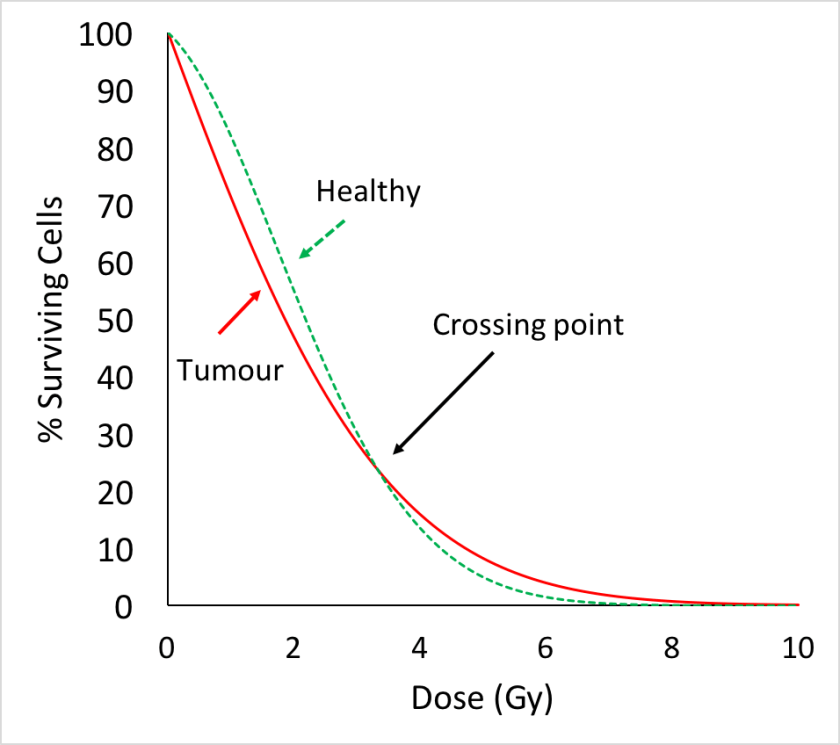
Cell survival curves predicted by the Linear Quadratic Model of Cell Survival. When the dose is below the crossing point, tumour cells are more likely than healthy cells to be killed by the radiation. When the dose is above the crossing point, tumour cells are less likely than healthy cells to be killed by the radiation. Both types of cells are less likely to survive as dose increases. Gray (Gy) is a unit of energy per mass used to measure the strength of the dose.
The Model
I made my model of fractionated radiation treatment using NetLogo, an open-source educational modelling platform. The model is intended for a high school or undergraduate audience. To get a copy of the model, send me a message.
The model has two types of cells: tumour cells (red) and healthy cells (green). The cells respond to radiation according to the Linear Quadratic Model of Cell Survival. The user sets the number of fractions, time between fractions, and the dose per fraction.
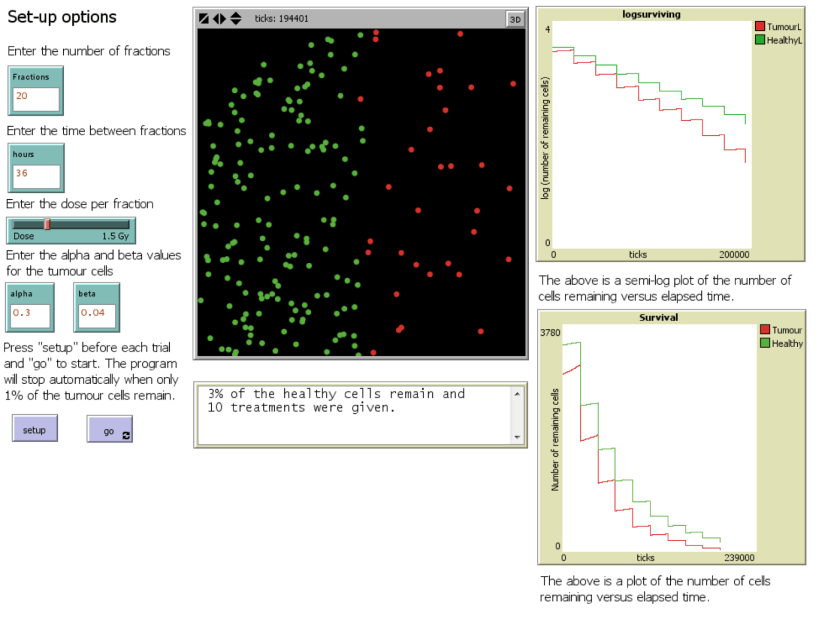
Screenshot of the NetLogo model. The plots and visualization updates with time as the cells divide and die.
 Kasperak